
Iran | Discover Iran 16 days
Description
Iran | Discover Iran 16 days
Itinerary
Day 01: Arr. Tehran. Transfer to the hotel.
Day 02: After breakfast visit Saadabad palace The Saadabad Palace is a palace built by the Pahlavi dynasty of Iran in the Shemiran area (north) of Tehran. This garden was the summer residence of Qajar Dynasty and has an area of 110 hectares. (275 acres), Reza Shah first lived there in the 1920s. Mohammad Reza Pahlavi moved there in the 1970s. A.er the Iranian Revolu/on it became a museum.
Then visit the National Museum of Iran, aging more than 70 years, containing 300,000 museum objects in an area more than 20,000 square meters, is not only the largest museum of History and Archaeology of the country, but ranks as one of the few most prestigious museums of the world in regard to grand volume, diversity and quality of its huge monuments. In the Iranian museum tradition it is considered Iran’s mother museum, aiming at preserving relics of the past to hand down to the next generations, enhancing better understanding among world peoples and nations, discovering and showing Iranian’s roles in shaping world culture and civilization and trying to enhance public knowledge & {Jewelry museum, exp Wednesday till Friday}, Carpet museum. Lunch & Dinner in local
Day 03: Tehran-Hamedan
Drive to Hamadan; visit Estaromardkhai & Tomb of Avesina & Alavian Tomb {the new memorial structure of the tomb of Avecina (Bu Ali Sina) was constructed in the year 1941 right in its former location. From the architectural aspect the dome of the said structure is an inspiration from 'The Gonbad-e-Qaboos' in the plains of Gorgan, and 'Persepolis' or Takht-eJamshid. In the museum here, ancient relics, an anthropology section and books of Avecina are on display. Besides which exhibits such as bronze statues related to the 1st millennium BC., gourd bottles (or canteens), coins, beads and articles of silver related to the Sassanide period. The tomb of the great Gnostic 'Qazvini' is also located in this vicinity} . Overnight in the hotel.
Day 04: Hamedan - Kermanshah
Drive to Kermansah and visit Tagh Bostan Taqwasân or Taq-e Bostan or Taq-i-Bustan (Persian: ن ق (is a series of large rock relief from the era of Sassanid Empire of Persia, the Iranian dynasty which ruled western Asia from 226 to 650 AD. This example of Sassanid art is located 5 km from the city center of Kermanshah in western Iran. It is located in the heart of the Zagros mountains, where it has endured almost 1,700 years of wind and rain. The carvings, some of the finest and best-preserved examples of Persian sculpture under the Sassanids, include representations of the investitures of Ardashir II (379–383) and Shapur III (383–388). Like other Sassanid symbols, Taq-e Bostan and its relief patterns accentuate power, religious tendencies, glory, honor, the vastness of the court, game and fighting spirit, festivity, joy, and rejoicing. Sassanid kings chose a beautiful setting for their rock reliefs along an historic Silk Road caravan route waypoint and campground. The reliefs are adjacent a sacred spring that empties into a large reflecting pool at the base of a mountain cliff. Taq-e Bostan and its rock relief are one of the 30 surviving Sassanid relics of the Zagros mountains. According to Arthur Pope, the founder of Iranian art and archeology Institute in the USA, "art was characteristic of the Iranian people and the gift which they endowed the world with." Continue visit to Bistoon & Kangavar. Overnight in the hotel
Day 05: Kermanshah - Ahvaz
Drive to Ahvaz & Visit Susa & Chogha Zanbil
CHOGHAZANBIL Is a Ziggurat,a large stepped pyramidal temple and the greatest ziggurat in the world, is in UNESCO's World Heritage List as the best preserved kind of ziqqurat. It was the first site registered among 8 Iranian UNESCO WHL inscribed sites. And was built about 3300 years ago by king Untash-Napirisha, the emperor of Elamite to honor of their great god, Inshushinak, the protector of Susa. Elamites were one of the earliest civilizations in the world at the golden age of Mesopotamian civilizations which lived along with the rivers of Khuzestan. Overnight in the hotel.
Day 06: Ahvaz - Shiraz Drive to Shiraz and on the way visit Bishapour the city which built by Shapour I and included palaces with a large fire-temple and inscriptions of the Pahlavi script. The main palace has a hall with many corridors and various varandas and gardens.The plan of the hall is 20 sided. Overnight in the hotel.
Day 07: Shiraz Full day city tour and visit Eram Garden is a historic Persian garden in Shiraz, Iran. Eram is the Persianized version of the Arabic word "Iram" meaning heaven in the Muslim's book of Koran. Eram Garden therefore is so called for its beauties and aesthetic attractions resembling "heaven." This garden is located on the northern shore of the Kushk river in the Fars province. Both pavilion and the garden are built during the middle of nineteenth cenutry by the Ilkhanate or a paramount chief of the Qashqai tribes of Pars. The original layout of the garden however, with its quadripartite Persian structure was most likely laied in eighteenth century by the Seljuqs, and was then referred to as the "Bagh-e-Shah" (meaning the "garden of the king" in Persian) and was much less complicated or ornamental. Visit Tomb of Hafez which has been built in Shiraz and is dedicated to the Persian poet Hafez. There is also a memorial hall called the Hafezieh which also has an open pavilion structure like the burial place. Located in the Musalla gardens, it has a seasonal river flowing beside it. The structures that exist today were built in 1935 by Andre Godard, the French architect and archaeologist. The best of the monuments here was built in 1773 at the /me of Karim Khan Zand. Tourists throng to this place to see the tomb, memorials and gardens when they travel to Iran. Similarly and even more fervently, Iranians come to this place joyfully and enjoy it very much. Visit to Saadi and continue to visit Karimkhani citadel which used to be the main residential palace of Karim Khan-e-Zand and his dynasty in Shiraz. Surrounded by high brick walls, there are four towers, each at a corner of the complex. This place was used as a prison for thirty five years un/l 1971. Although damaged as a result of misuse, renova/ons are taking place. This monument is a good representative of the architectural style which was typical of the Zand period. Visit to Bazzar. Overnight in the hotel.
Day 08: Shiraz
Excursion to Persepolis & Naghshe rostam which is an archaeological site located about 12 km northwest of Persepolis, in Fars province, Iran. Naqsh-e Rustam lies a few hundred meters from Naqsh-e Rajab. The oldest relief at Naqsh-i Rustam is severely damaged and dates to c. 1000 BC. It depicts a faint image of a man with unusual head-gear and is thought to be Elamite in origin. The depiction is part of a larger mural, most of which was removed at the command of Bahram II. The man with the unusual cap gives the site its name, Naqsh-e Rostam, "Picture of Rostam", because the relief was locally believed to be a depiction of the mythical hero Rostam. Visit to Naghshe Rajab. Drive back to Shiraz. Overnight in the hotel.
Day 09: Shiraz - Yazd
Drive to Yazd and on the way visit Pasargad which was first archaeologically explored by the German archaeologist Ernst Herzfeld in 1905, and in one excavation season in 1928, together with his assistant Friedrich Krefter. Since 1946, the original documents, notebooks, photographies, fragments of wall paintings and pottery from the early excavations are preserved in the Freer Gallery of Art, Smithsonian Institution, in Washington, DC. The construction of the capital city by Cyrus the Great, begun in 546 BCE or later, was left unfinished after Cyrus died in battle in 530 or 529 BCE. The tomb of Cyrus' son and successor, Cambyses II, also has been found in Pasargadae. The remains of his tomb, located near the fortress of Toll-e Takht, were identified in 2006. Visit to Abarkouh. Overnight in the hotel.
Day 10: Yazd – Isfahan
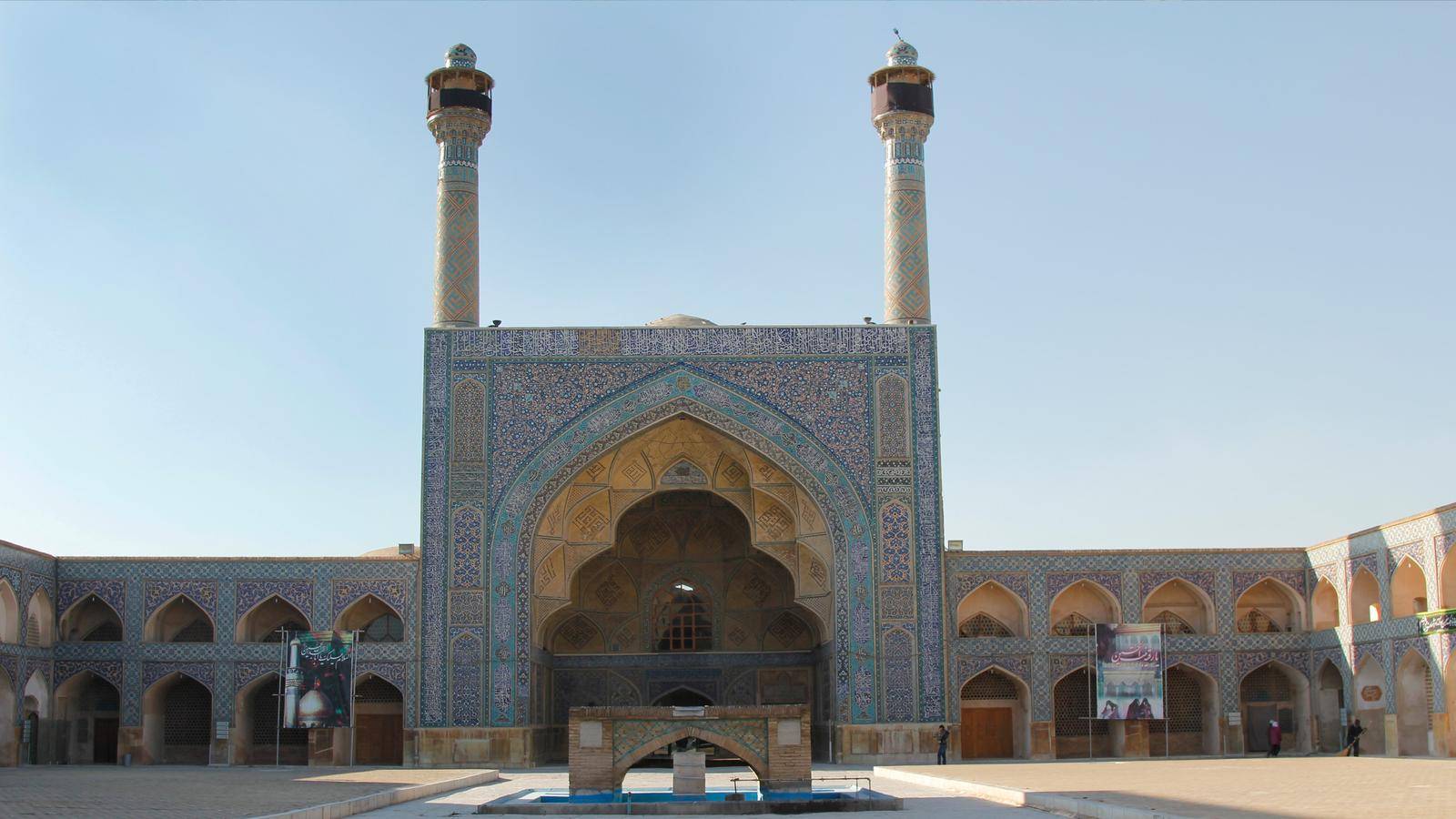
Drive to Isfahan & on the way visit Naeen (Jame mosque) which is the grand, congregational mosque (Jame) of Nā'īn city, within Isfahn Province of Iran. Although the mosque is one of the oldest in Iran, it is still in use and is protected by Iran's Cultural Heritage Organization. Overnight in the hotel.
Day 11: Isfahan Full day city tour and visit Imam Mosque & Aliqapoo palace continue to visit Lotfollah mosque of the four monuments that dominated the perimeter of the Naqsh-e Jahan square, this one was the first to be built. The purpose of this mosque was for it to be a private mosque of the royal court, unlike the Masjed-e Shah, which was meant for the public.[1] For this reason, the mosque does not have any minarets and is of a smaller size. Indeed, few Westerners at the time of the Safavids even paid any attention to this mosque, and they certainly did not have access to it. It wasn't until centuries later, when the doors were opened to the public, that ordinary people could admire the effort that Shah Abbas had put into making this a sacred place for the ladies of his harem, and the exquisite tile- work, which is far superior to those covering the Shah Mosque. Chehel sotun & Bazzar. Over night in the hotel.
Day 12: Isfahan Full day city tour. Visit Vank church or Vank Cathedral was one of the first churches to be established in the city's Jolfa district by Armenian immigrants settled by Shah Abbas I after the Ottoman War of 1603-1605. The varying fortunes and independence of this suburb across the Zayandeh River and its eclectic mix of European missionaries, mercenaries and travelers can be traced almost chronologically in the cathedral's combination of building styles and contrasts in its external and internal architectural treatment. Visit Hasht Behesht which Located in the center of the Garden of Nightingales (the Bagh-e Bulbul), the Hasht Behesht is one of Isfahan's two surviving Safavid pavilions. Built under Shah Sulaiman some twenty years after the Chihil Sutun, it is quite different in style from the earlier pavilion, although it exhibits the same concern for the interplay of interior and exterior spaces. 'Hasht Behesht' translates as 'Eight Paradises' and refers to a Timurid palace building type consisting of two stories of four corner rooms around a central domed space. In Isfahan, the corner rooms are octagonal, forming massive pillars that define four large openings leading to large porches in the south, east and west, and an iwan in the north. Then, visit to Shaking menareh. Overnight in the hotel.
Day 13: Isfahan - Kashan – Teheran
Drive to Tehran via Kashan and visit Fin garden,The origins of the garden may be anterior to the Safavid period; some sources indicate that the garden has been relocated from another place, but no clear picture of it has been found. The settlements of the garden in its present form was built under the reign of Abbas I of Persia (1571- 1629), as a traditional bagh near the village of Fin, located a few miles southwest of Kashan.[2] The garden was developed further during the Safavid dynasty, until Abbas II of Persia (1633-1666). It was highly recognized during the reign of Fat′h Ali Shah Qajar and was considerably expanded. The garden subsequently suffered from neglect and was damaged several times until, in 1935, it was listed as a national property of Iran. On 2007, 8 September, Bagh-e Fin was submitted to the Unesco Tentative List. Continue visits to Tabatabaee house & Borujerdi House. Overnight in the hotel
Day 14: Teheran Visit Galss museum & Golestan Palace,The oldest of the historic monuments in Tehran, the Golestan Palace (also Gulistan Palace) (The Rose Garden Palace) belongs to a group of royal buildings that were once enclosed within the mud-thatched walls of Tehran’s Historic Arg (citadel). The Arg was built during the reign of Tahmasp I (r. 1524-1576) of the Safavid dynasty (1502–1736), and was later renovated by Karim Khan Zand (r. 1750-1779). Agha Mohamd Khan Qajar (1742–1797) chose Tehran as his capital. The Arg became the site of the Qajar (1794–1925). The Court and Golestan Palace became the official residence of the royal Qajar family. The palace was rebuilt to its current form in 1865 by Haji Abol-hasan Mimar Navai. During the Pahlavi era (1925–1979) Golestan Palace was used for formal royal receptions and the Pahlavi dynasty built their own palace at Niavaran. The most important ceremonies held in the Palace during the Pahlavi era were the coronation of Reza Khan (r. 1925-1941) in Takht-e Marmar and the coronation of Mohammad Reza Pahlavi (r. 1941-deposed 1979) in the Museum Hall. In between 1925 and 1945 a large portion of the buildings of the palace were destroyed on the orders of Reza Shah who believed that the centuries old Qajar palace should not hinder the growth of a modern city. In the place of the old buildings modern 1950s and 1960s style commercial buildings were erected. Visit to Abbasi museum & Bazzar. Overnight in hotel
Day 15: Tehran, Full day free at leisure
Day 16: Departure.